0hmX/mt41k512m8da-107-it-p-fanout
This code defines the physical footprint, routing, and layout configuration for a DDR3 memory module using surface-mount pads, vias, and copper traces on a printed circuit board (PCB).
- Version
- 0.2.3
- License
- unset
- Stars
- 0
scripts/generate.ts
import { PIN_MAP } from "../src/pin-map"
import { LAYOUT_PROFILES, PROFILE_LAYOUTS, RULES, BREAKOUT, getExitLayer } from "../src/profiles"
import { PAIRS, MATCH_GROUPS, TUNING, getEdgeY } from "../src/timing"
import { fanoutTracePath, type FanoutTracePath } from "@tscircuit/props"
const planarLength=(route:FanoutTracePath['route'])=>route.reduce((sum,b,i)=>{
 const a=route[i-1]
 return sum+(a?.route_type==='wire'&&b.route_type==='wire'&&a.layer===b.layer?Math.hypot(Number(a.x)-Number(b.x),Number(a.y)-Number(b.y)):0)
},0)
for (const profile of LAYOUT_PROFILES) {
 const layout=PROFILE_LAYOUTS[profile]
 const paths=PIN_MAP.filter(p=>p.routed).map(p=>{
   const sign=Math.sign(p.x)
   const dx=sign*(layout.xDirection==="outward"?1:-1)*0.4
   const dy=layout.yDirection==="north"?0.4:-0.4
   const x=p.x+dx,y=p.y+dy,layer=getExitLayer(p.ball)
   const wire=(x:number,y:number)=>({route_type:'wire' as const,x,y,width:RULES.traceWidth,layer})
   const route:FanoutTracePath['route']=layer==='top'?[wire(p.x,p.y),wire(sign*TUNING.topTuningStartX,p.y)]:[
     {route_type:"wire",x:p.x,y:p.y,width:RULES.traceWidth,layer:"top"},
     {route_type:"wire",x,y,width:RULES.traceWidth,layer:"top"},
     {route_type:"via",x,y,from_layer:"top",to_layer:layer,via_diameter:RULES.viaDiameter,via_hole_diameter:RULES.viaDrill},
     // Exit diagonally into the inter-row channel instead of a vertical/horizontal L.
     wire(x,y),wire(x+sign*Math.abs(dy),p.y),
   ]
   if(layer!=='top'&&Math.abs(Number(route.at(-1)!.x)-sign*TUNING.startX)>.001)route.push(wire(sign*TUNING.startX,p.y))
   const edgeY=getEdgeY(p)
   if(edgeY!==p.y) {
    route.push(wire(sign*TUNING.pairConvergenceStartX,p.y))
    route.push(wire(sign*(TUNING.pairConvergenceStartX+Math.abs(edgeY-p.y)),edgeY))
   }
   route.push(wire(sign*BREAKOUT.halfWidth,edgeY))
   return fanoutTracePath.parse({connection:`U1.ball_${p.ball}`,route})
 })
 const pathFor=(terminal:string)=>paths.find(path=>path.connection===`U1.ball_${PIN_MAP.find(p=>p.terminal===terminal)!.ball}`)!
 for(const group of Object.values(MATCH_GROUPS)) {
  const target=Math.max(...group.map(n=>planarLength(pathFor(n).route)))
  for(const terminal of group) {
   // Keep paired tails straight and symmetric. Their nominal fabrication-coordinate
   // rounding mismatch is below the explicit 0.005 mm acceptance threshold.
   if(PAIRS.some(pair=>pair.includes(terminal))) continue
   const path=pathFor(terminal),pin=PIN_MAP.find(p=>p.terminal===terminal)!
   const extra=target-planarLength(path.route)
   if(extra<1e-8)continue
   const sign=Math.sign(pin.x),layer=getExitLayer(pin.ball)
   const wire=(x:number,y:number)=>({route_type:'wire' as const,x:sign*x,y,width:RULES.traceWidth,layer})
   // Fit broad tuning cells inside the 1 mm body padding.
   // Top ODT/CKE use the vacant adjacent NC rows for vertical tuning room.
   // A small correction gets one 45-degree trapezoid, never a train of
   // sub-trace-width ripples. Larger corrections use 1–2 chamfered trombones.
   const count=layer==='top'?2:Math.ceil(extra/.8),perCell=extra/count
   const trapezoid=perCell<.25
   const c=.12
   const h=trapezoid?perCell/(2*(Math.SQRT2-1)):perCell/2+2*c*(2-Math.SQRT2)
   if(h>(layer==='top'?1.1:.55)||count>2)throw Error(`Tuning corridor exceeded for ${terminal}: ${h}`)
   const end=path.route.pop()!
   for(let i=0;i<count;i++){
    const a=(layer==='top'?TUNING.topTuningStartX:TUNING.startX)+.15+i*(layer==='top'?.72:.8),b=a+(layer==='top'?.6:.65),y=pin.y
    if(trapezoid){
     path.route.push(wire(a,y),wire(a+h,y+h),wire(b-h,y+h),wire(b,y))
    }else{
     path.route.push(wire(a,y),wire(a+c,y+c),wire(a+c,y+h-c),wire(a+2*c,y+h),wire(b-2*c,y+h),wire(b-c,y+h-c),wire(b-c,y+c),wire(b,y))
    }
   }
   path.route.push(end)
   if(Math.abs(planarLength(path.route)-target)>1e-7)throw Error(`Length tuning failed: ${terminal}`)
  }
 }
 await Bun.write(`src/generated/${profile}.trace-paths.json`,JSON.stringify(paths,null,2)+"\n")
}
Related Packages
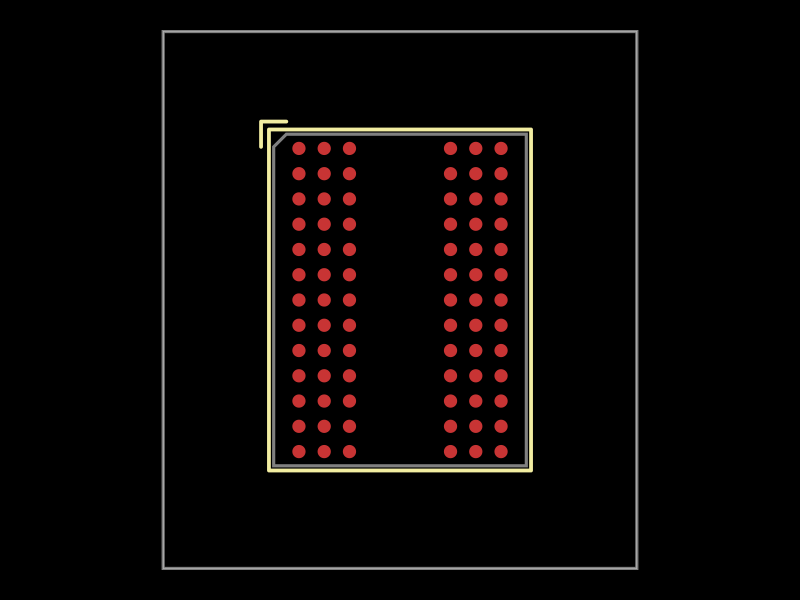 More from this author0hmX/mt41k512m8da-107-it-p-footprintsThis code defines the mechanical and physical layout of a Micron digital ball grid array (FBGA) package with 78 balls, including pin positions, footprint geometry, PCB pads, and silkscreen outlines for surface-mount integration.
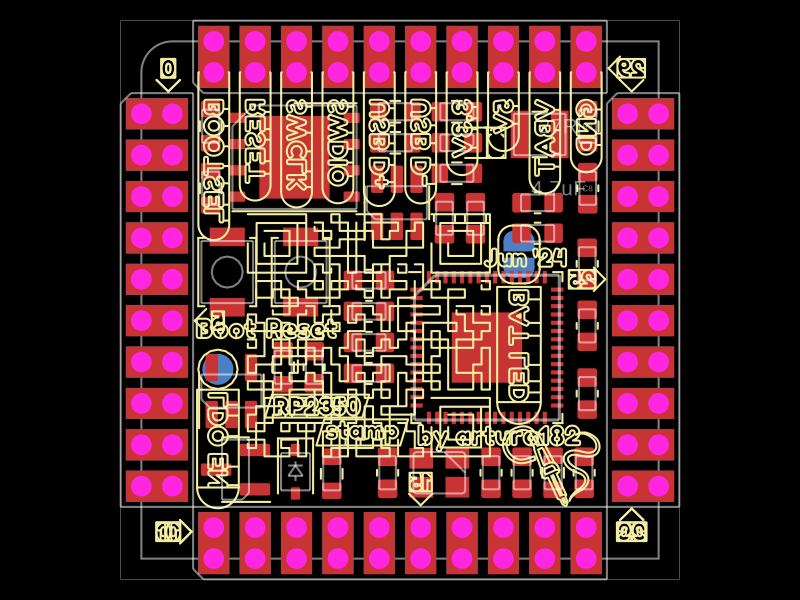 Similar packagetechmannih/imported-rp2350-stamp-boardThis code defines a detailed PCB layout with multiple layers, including the physical outline, component footprints, drilling holes, SMT pads, silkscreen markings, and courtyard outlines for component placement and board edges.
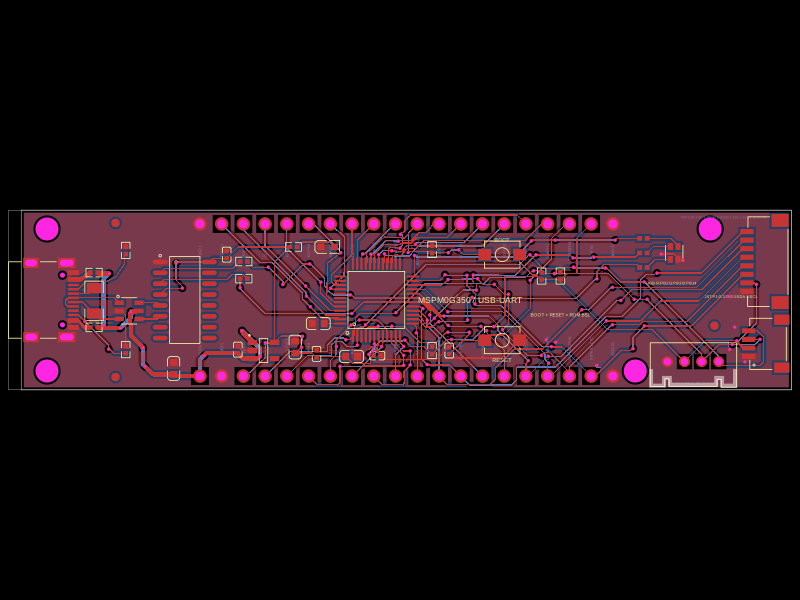 Discover something newShiboSoftwareDev/mspm0g3507-usb-c-dev-boardThe circuit assembles a USB-C port with integrated ESD protection, power regulation, UART interface, and microcontroller (MSPM0G3507) with supporting components for USB data lines, CC termination, I2C, SPI, reset circuitry, and indicator LEDs.